Build conversational forms that turn visitors into follow-up-ready leads

DialogMaker helps small business websites replace static contact forms with guided intake flows that ask one focused question at a time, capture lead details, and save every answer for follow-up.
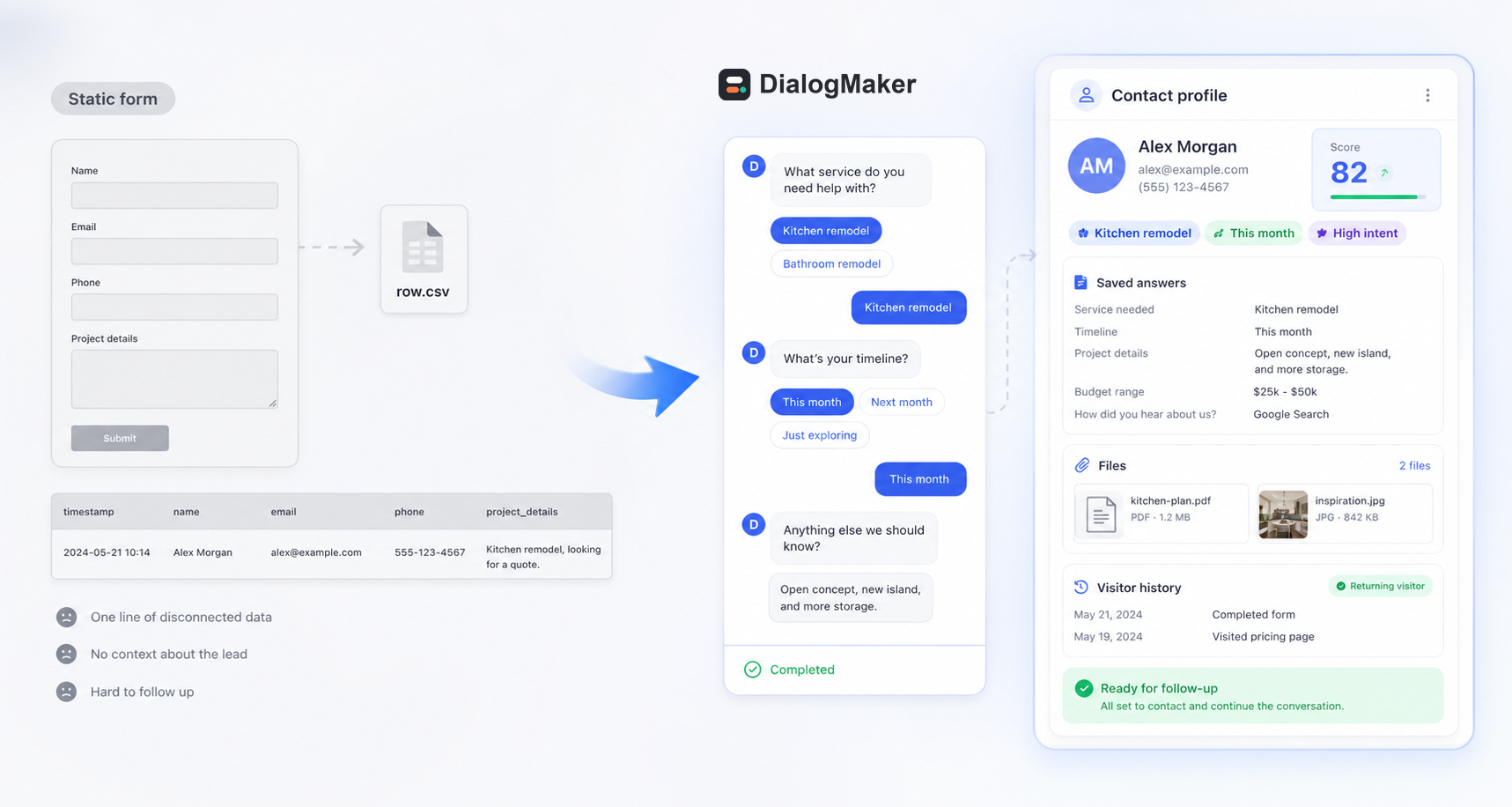
Static website form data compared with a DialogMaker conversational form and rich contact profile

What is a conversational form builder?

A conversational form builder is a tool for creating forms that ask visitors one question at a time in a guided, chat-like flow. It helps teams collect structured answers without presenting a long static form all at once.

Build a conversational form

Build forms that feel like website chats

DialogMaker lets you publish guided workflows as a website widget or public flow. Visitors answer step by step, while your team controls the questions, branches, and lead capture path behind the experience.

  • No-code website widget Launch intake flows on small business websites without a custom form build.
  • Embedded or public workflows Use the flow where visitors are most likely to ask for help.
  • Guided questions Keep each step focused and collect the details your team needs.

Common conversational form workflows

These are not just form types. They are the moments where a visitor needs guidance before your team can follow up well.

Use it when

The visitor has to explain the request before you can follow up.

DialogMaker is for website moments where a plain field list is not enough: the answer changes the next question, files matter, or your team needs context before replying.

Collect
Scope, timing, budget, files, and fit signals.
Guide
Branch only when the visitor's answer changes the path.
Deliver
A complete contact profile ready for follow-up.

Quote requests

Ask for service, scope, budget, timing, and files without dumping every field on the visitor at once.

Your team gets the request, uploaded files, and contact history together.

Client intake

Collect goals, requirements, preferences, and constraints in a flow that feels like a guided first call.

Every answer stays attached to the same client profile.

Lead qualification

Branch based on fit, urgency, budget, or service type so better leads arrive with better context.

High-fit leads arrive with qualification context. Start with lead scoring

Appointment requests

Ask what the visitor needs, when they want help, and how your team should reach them.

The follow-up starts from a clear request, not an empty inbox.

Why conversational forms can work better than static forms

Static forms are direct, but they can feel heavy when a visitor has to answer many fields at once. Conversational forms help break that request into smaller decisions while still collecting structured data.

  1. Each step asks one focused question, which can make complex requests feel less intimidating.
  2. Conditional paths can keep visitors from seeing irrelevant fields.
  3. A chat-style widget can meet visitors where they already are on your website.
  4. The conversation format gives your team cleaner context than a plain notification email.

What happens after someone submits

In a typical form tool, the response lands like a gray CSV-style row. In DialogMaker, the answers become a complete contact profile your team can actually use.

Typical builders

CSV-style row

Alex intake today file.pdf
Hard to read. Easy to ignore.
Contact profile
AM

Alex Morgan

alex@example.com

(555) 123-4567

Score 82
Kitchen remodel This month High intent

Saved answers

Service needed
Kitchen remodel
Timeline
This month
Project details
Open concept, new island, and more storage.
Budget range
$25k - $50k

Files

2 files
kitchen-plan.pdf inspiration.jpg

Visitor history

Returning visitor
May 21, 2024
Completed form
May 19, 2024
Visited pricing page
Ready for follow-up All set to contact and continue the conversation.

DialogMaker vs typical form builders

DialogMaker is not trying to be every form tool for every use case. It is focused on website lead workflows where the next step matters as much as the submission.

Typical form builders

  • Submission storage A row in a table or an email notification
  • Follow-up context Your team has to reconstruct what happened
  • Returning visitors They usually start from scratch
  • Qualification Manual review after a generic submission

DialogMaker

  • Submission storage A contact profile with saved answers, files, and history
  • Follow-up context The next person sees the full conversation before replying
  • Returning visitors Returning visitor memory helps preserve context
  • Qualification Branches, tags, notes, and scores support follow-up workflows

FAQ

Conversational form builder FAQ

Answers for teams replacing static forms with guided website intake flows.

What is a conversational form builder?

A conversational form builder is software for creating forms that ask one question at a time in a guided, chat-like flow. Instead of showing every field at once, the form moves the visitor through focused prompts and records each answer.

How is a conversational form different from a regular form?

A regular form usually shows a static set of fields on one page. A conversational form presents questions step by step, can branch based on previous answers, and often feels closer to a website chat or guided intake.

Can I embed conversational forms on my website?

Yes. DialogMaker is built for website lead capture, so you can use a no-code website widget or share a public workflow link depending on how you want visitors to start the flow.

Can conversational forms qualify leads?

Yes. You can ask qualification questions, collect fit and urgency signals, and use lead scoring where appropriate so your team has more context before following up.

What happens to answers after submission?

DialogMaker saves answers to a contact profile with history, notes, tags, and follow-up context. That gives your team a clearer starting point than a disconnected submission notification.

Build a conversational form for your website

Start with a lead capture workflow that collects answers, saves the contact, and gives your team better follow-up context.

Start with lead generation